
Checking the balloon volume of an indwelling catheter may seem like a simple procedure, but it is one that requires careful consideration. In daily care, balloon checks are not a standard part of catheter policy. Nevertheless, there are situations where it **is** necessary to prevent complications and ensure the client's comfort.
In this article, we outline the main points of attention, based on current guidelines and practical experience.
The function of the balloon
A Foley catheter remains in place thanks to a balloon that is filled with sterile water. This balloon prevents the catheter from slipping out of the bladder. With silicone catheters, the balloon volume can slowly decrease due to diffusion: sterile water disappearing through the balloon wall under the influence of concentrated urine. This can cause the catheter to become loose or even fall out.
When do you check the balloon contents?
Balloon checks only occur when there is a clear reason for them. Routine checks are not recommended, as unnecessary manipulation of the catheter carries risks.
Indications for balloon control
- Leakage along the catheter
- Pain, a feeling of pressure, or bladder cramps in the client
- Suspect the catheter is looser than usual
- (Near) catheter failure
- Suspicion of balloon defect or diffusion
- Manufacturer's advice for 100% silicone catheters (sometimes periodic check)
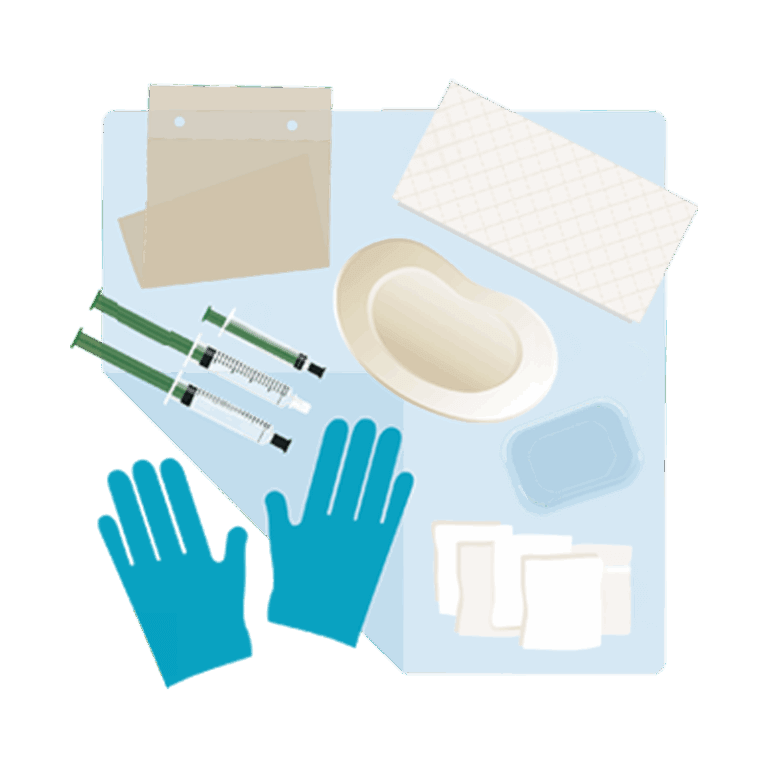
Hekura Catheter Set Clean
Towards sustainable care Clean rather than sterile bladder catherisation

When not to check
- Without complaints or signals
- With clients where manipulation carries risks, for example after a recent operation
- When the balloon filling is already known and there are no indications of change
What do you check when filling balloons?
- Always use Sterile water, unless otherwise specified by the manufacturer.
- Fill the balloon solely with the prescribed amount (usually 5–10 ml).
- Note the original balloon fill in the file.
- Check only when it is safe and appropriate within the prevailing protocol.
How do you check the balloon contents?
Checking the balloon contents is a relatively simple operation, but requires carefulness. The steps below align with the protocols used in practice.
- Preparation of the deed Ensure a calm and hygienic working environment. Check the prescription and gather all necessary materials before you begin.
- Catheter fixation assessment Check whether the catheter is in the correct position and look for signs such as leakage, tension on the catheter, or possible displacement.
- Subtracting balloon volume Allow the liquid to drain from the balloon through the valve, and accurately record the amount released. This will provide insight into any deviations.
- Refill balloon Re-infuse the prescribed amount of sterile water into the balloon and check that the catheter is stable again afterwards.
- Evaluate and report Observe how the client experiences the procedure and check if any complaints arise. Document all findings carefully in the file.
Possible complications
- Catheter failure
- Pain or bladder spasms due to an overfilled balloon
- Leakage due to an underinflated balloon or balloon defect
- Repeated deflation by diffusion in silicone catheters
When in doubt, always consult with a doctor or specialist nurse.
Practical considerations
- Encourage adequate fluid intake to reduce urine concentration.
- Always follow manufacturer's instructions and organisational protocol.
- Never force it; resistance may indicate a problem.
- Always observe the client's comfort and urine output afterwards.
Conclusie
Checking the balloon volume of an indwelling catheter is not a standard procedure, but can be essential in specific situations to prevent complications. By working carefully and following the applicable guidelines, the healthcare professional contributes to safe and comfortable catheter care.
Disclaimer
Note: Catheterisation is a medical procedure that should only be performed on the advice of a doctor or nurse. Never start catheterisation on your own initiative. The correct choice of catheter, technique and hygiene are essential for safe application.
Wij hebben dit blogartikel met de grootst mogelijke zorgvuldigheid geschreven met behulp van externe deskundigen. Ondanks de betrachte zorgvuldigheid staat van Heek Medical er niet voor in dat de informatie volledig, juist en/of up-to-date is. De informatie is uitsluitend bedoeld als algemene informatie. Van Heek Medical is niet aansprakelijk, uit welke hoofde dan ook, voor schade die voortvloeit uit en/of verband houdt met de informatie. Deze informatie is nimmer een vervanging voor medische zorg. Ieder mens is uniek. Kennelijke vergissingen of kennelijke fouten binden Van Heek Medical niet.